
Getting the measurements right is one of the most important parts of ordering a PVC strip curtain.
Fortunately, measuring your doorway is straightforward. In most cases, we only need a few basic measurements to work out the correct curtain size, number of strips, overlap and hanging rail required.
In this guide, we’ll show you exactly how to measure for PVC strip curtains, explain the difference between face fixing and soffit fixing, and highlight the common mistakes to avoid before ordering.
What Measurements Do I Need for a PVC Strip Curtain?
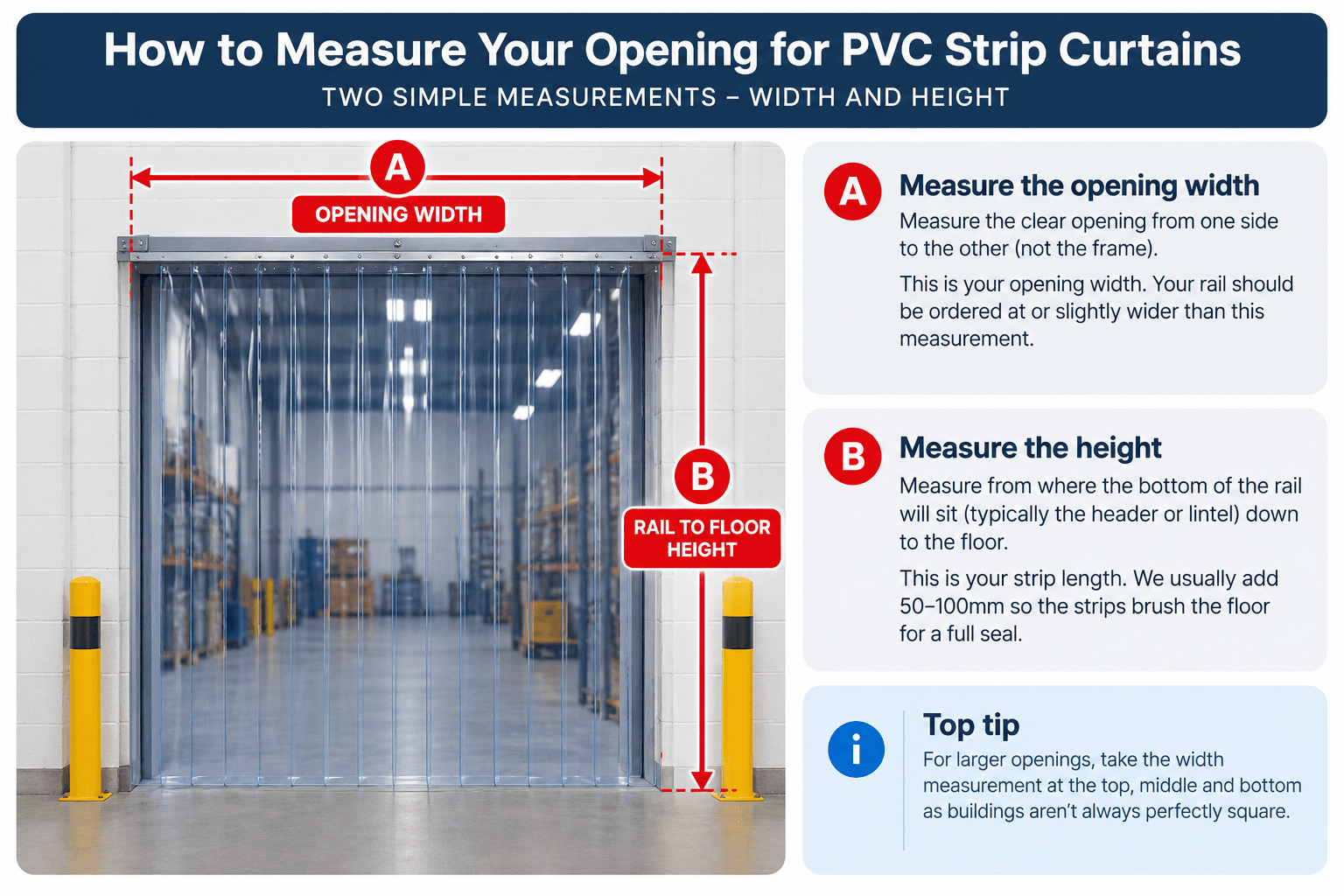
For most PVC strip curtain installations, start with two measurements:
- Opening width
- Opening height
We also need to know where you intend to fit the hanging rail, because this can affect the finished dimensions of your curtain.
If you’re unsure about the installation position, don’t worry. Send us your doorway dimensions and, ideally, a photograph of the opening, and our team can help specify the most suitable arrangement.
Step 1: Measure the Width of the Opening
Measure the clear opening from one side to the other.
For example:
Opening width: 2,400mm
Try to measure the usable doorway itself rather than simply measuring the overall external dimensions of the door frame.
For larger openings, it can be useful to take a measurement:
- Across the top
- Across the middle
- Across the bottom
Older industrial buildings and warehouse openings aren’t always perfectly square.
If the measurements differ slightly, send us all three measurements and we can advise which dimension should be used.
Don’t Automatically Make the Curtain the Same Width as the Opening
This is where PVC strip curtain measuring is slightly different from measuring something like a conventional door.
Where possible, we generally recommend installing the curtain on the face above the doorway rather than inside the opening.
This allows the curtain to extend slightly beyond the edges of the doorway, helping reduce draughts and air movement around the sides.
If you’re fitting the curtain inside the opening, let us know when ordering because the rail width needs to be calculated differently.
Step 2: Measure the Height
Next, measure from the proposed position of the hanging rail down to the floor.
For example:
Rail position to floor: 2,500mm
This measurement determines the required PVC strip length.
It’s important to measure from where the rail will actually be installed, rather than simply quoting the nominal door height.
There may be a lintel, steel beam, roller shutter mechanism or other structure above the doorway which changes the final hanging height.
Step 3: Decide Where the Rail Will Be Fitted
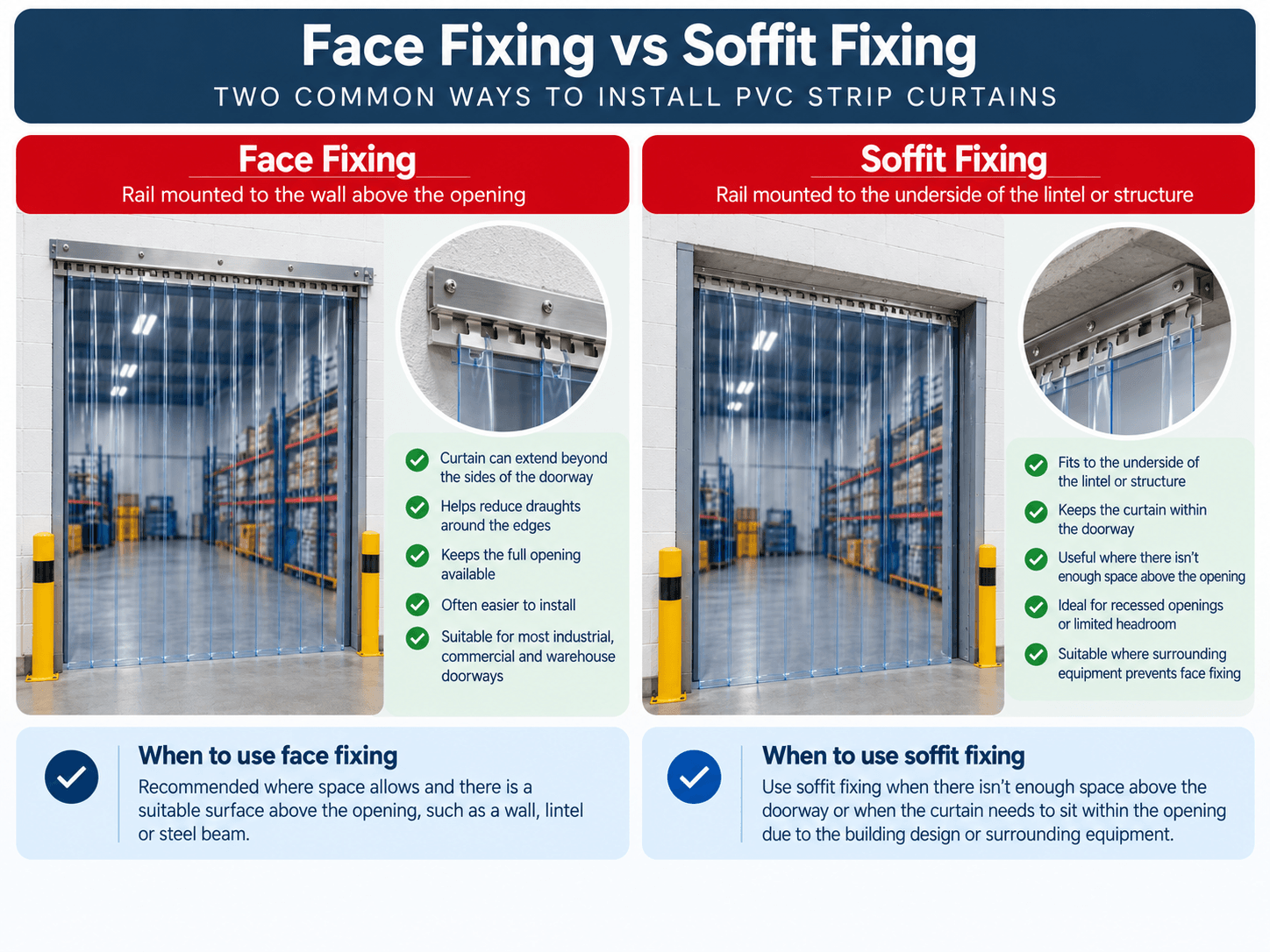
There are two common ways to install a PVC strip curtain.
Face Fixing
The rail is mounted vertically onto the wall, lintel or suitable supporting structure above the opening.
This is generally our preferred installation method where space allows.
Advantages of face fixing
- Curtain can extend beyond the sides of the doorway
- Helps reduce draughts around the curtain edges
- Often easier to install
- Keeps the full doorway opening available
- Suitable for many warehouse, factory and workshop installations
Unless you tell us otherwise, this is normally the type of installation we will assume when helping you specify a curtain.
Soffit Fixing
The rail is fitted horizontally to the underside of the lintel or structure above the opening.
This means the curtain normally hangs within the doorway itself.
Soffit mounting can be useful where:
- There isn’t enough space above the opening
- The curtain needs to sit within a recess
- Surrounding equipment prevents face fixing
- The installation design requires the curtain to remain inside the doorway
Tell us if you require a soffit-mounted curtain so that we can allow for this when specifying the rail and finished curtain dimensions.
Step 4: Check the Floor Level
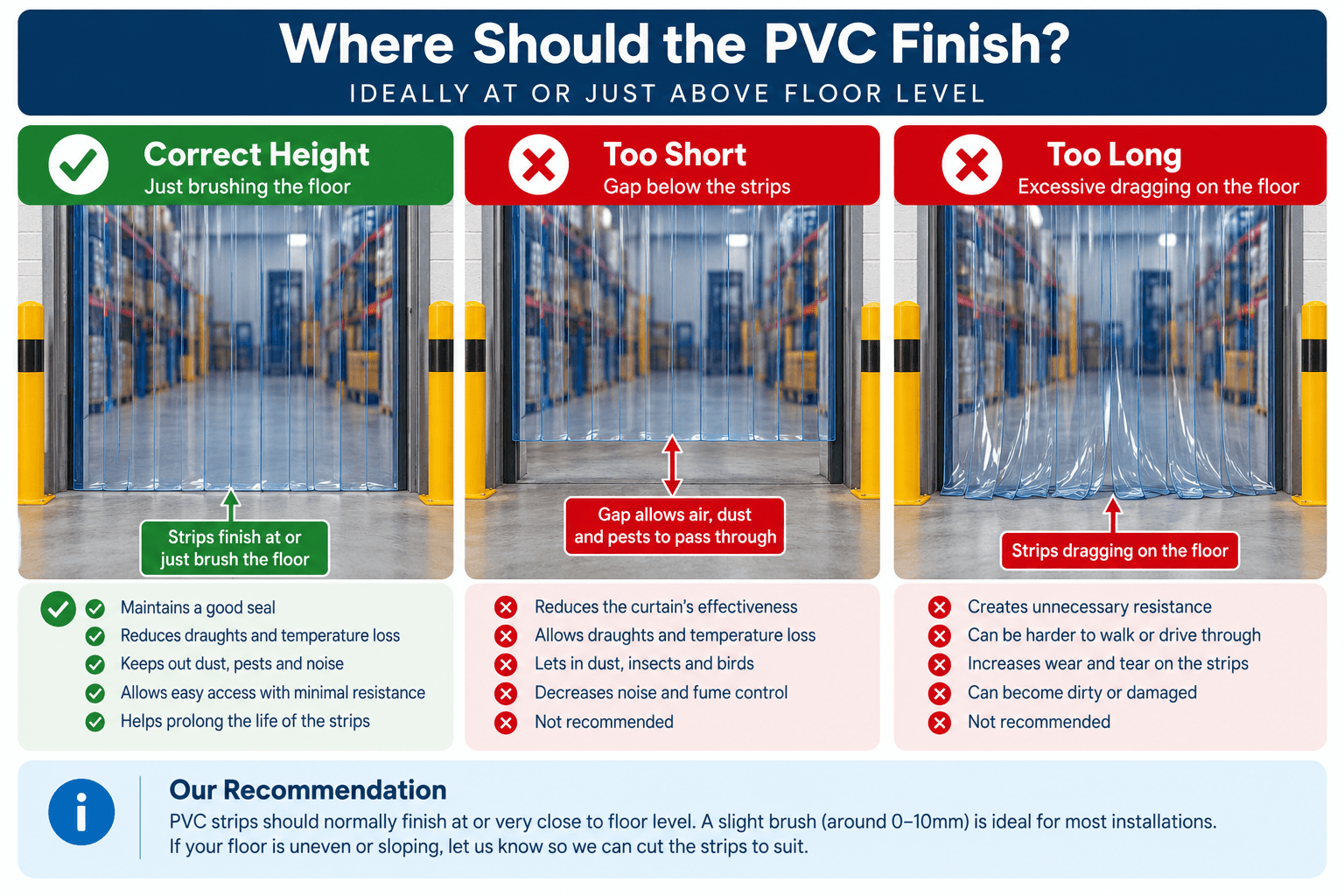
Before ordering, look at the floor underneath the curtain.
Is it:
- Flat and level?
- Sloping?
- Uneven?
- Raised on one side?
- Interrupted by a threshold or ramp?
Ideally, PVC strips should finish at or very close to floor level.
You don’t normally want excessive PVC dragging along the floor. This creates unnecessary resistance when passing through the curtain and can accelerate wear.
Equally, leaving a large gap underneath reduces the curtain’s ability to control:
- Draughts
- Heat loss
- Cold air loss
- Dust
- Noise
- Birds and pests
For uneven floors, take several height measurements across the opening and let us know the results.
Step 5: Choose the Correct PVC Strip Size
Not every doorway should use the same PVC strip.
The appropriate strip width and thickness depends primarily on:
- Opening height
- Type of traffic
- Frequency of traffic
- Internal or external installation
- Temperature
- Required level of environmental separation
Typical strip sizes include:
| PVC Strip Size | Typical Use |
| 200mm x 2mm | Personnel doors, smaller openings and light-duty applications |
| 200mm x 3mm | Smaller openings requiring additional durability |
| 300mm x 3mm | Warehouses, industrial doorways and medium-duty traffic |
| 300mm x 4mm | More demanding medium/heavy-duty applications |
| 400mm x 4mm | Large industrial openings and heavy-duty applications |
As the curtain becomes taller, wider and heavier strips are generally required to help maintain stability.
For example, Redwood’s standard Hook-On range includes 200mm strips for smaller openings, 300mm strips for larger warehouse applications and 400mm heavy-duty strips for substantial industrial openings.
Step 6: Choose the Correct Strip Overlap
PVC strip curtains aren’t normally installed with the strips simply touching edge-to-edge.
Instead, each strip overlaps the next.
This creates the barrier that helps reduce the movement of:
- Warm and cold air
- Draughts
- Dust
- Noise
- Fumes
- Birds and flying pests
The right overlap is a balance between environmental separation and ease of access.
Lower Overlap
A lower overlap makes the curtain easier to move through.
This can work well for:
- Personnel traffic
- Trolleys
- Busy internal doorways
- Areas where easy access is the priority
Higher Overlap
Increasing the overlap creates a heavier and more substantial barrier.
This may be appropriate for:
- Taller openings
- Exposed warehouse doors
- Cold areas
- Heavy industrial applications
- Areas requiring greater environmental separation
Redwood systems are available with several fixed overlap configurations depending on the strip width and hanging system, including:
36%, 50%, 60%, 63%, 77% and 100% overlap.
The correct percentage therefore isn’t something you need to calculate yourself.
Give us the opening dimensions and intended use, and we can recommend the appropriate combination.
Step 7: Tell Us What Will Be Passing Through the Curtain
Two doorways with identical dimensions may require completely different curtains.
For example, a 3-metre-high internal pedestrian doorway has very different requirements from a 3-metre-high warehouse door used by forklifts throughout the day.
When requesting a quote, tell us what will pass through the opening.
This could include:
- Pedestrians
- Trolleys
- Pallet trucks
- Forklifts
- Machinery
- Warehouse vehicles
This helps us determine the most suitable PVC strip width, thickness, overlap and hanging system.
Step 8: Consider the Temperature
Temperature is particularly important when measuring and specifying curtains for:
- Cold rooms
- Chillers
- Freezers
- Loading areas adjoining cold storage
- Refrigerated vehicles
Standard clear PVC is designed for normal ambient environments.
For sub-zero applications, Polar Grade PVC should normally be used because it remains flexible at temperatures down to approximately -24°C.
Using standard PVC inside a freezer can cause the material to become excessively stiff.
Likewise, Polar Grade PVC isn’t normally required for warm ambient environments.
Step 9: Choose the Hanging System
Once we know the dimensions and application, we can also determine which hanging system is most suitable.
Hook-On PVC Strip Curtains
Our traditional stainless steel Hook-On system is suitable for a huge range of:
- Warehouses
- Workshops
- Factories
- Cold rooms
- Commercial doorways
- Internal partitions
Individual PVC strips can easily be removed or replaced without changing the entire curtain.
QuickMount PVC Strip Curtains
Our UPVC QuickMount system is designed for lighter-duty applications and can be particularly useful for:
- Schools
- Nurseries
- Internal pedestrian areas
- Commercial environments
Swivel Hinge PVC Strip Curtains
For heavy-duty industrial and forklift applications, our Swivel Hinge system allows the strips to move more freely as traffic passes through.
TwinTrack PVC Strip Curtains
TwinTrack systems are designed for demanding industrial applications where additional environmental separation is required.
Unlike many fixed-overlap hanging systems, TwinTrack can also be configured with different levels of strip overlap.
PVC Strip Curtain Measuring Example
Imagine you have a warehouse doorway measuring:
Width: 2,500mm
Height: 2,800mm
The rail can be installed on the wall immediately above the doorway, and pallet trucks regularly pass through the opening.
Instead of simply ordering a curtain measuring exactly 2,500mm x 2,800mm, we would consider:
- Whether the curtain can extend beyond the doorway edges
- The final rail installation height
- The most suitable strip width and thickness
- Traffic passing through the curtain
- Required strip overlap
- Whether standard, ribbed or another PVC type would be preferable
We then calculate the number of PVC strips and rail required for the finished curtain.
This is why opening dimensions are usually more useful to us than trying to calculate the number of strips yourself.
Measuring Around a Roller Shutter Door
Roller shutter doors require slightly more consideration.
The PVC curtain will normally be installed behind the roller shutter, but there may not be a suitable mounting surface immediately above the opening.
In some installations, a suitable steel support beam needs to be installed behind or below the roller shutter mechanism so that the PVC curtain rail has a structural surface to attach to.
Remember: PVC strip curtain rails are not self-supporting.
If you have a roller shutter installation and aren’t sure where the curtain can be mounted, send us a photograph taken from inside the building showing:
- The full doorway
- Roller shutter mechanism
- Steelwork above the opening
- Brickwork or pillars either side
We can normally identify the best mounting arrangement from this.
Common PVC Strip Curtain Measuring Mistakes
1. Measuring the Door Instead of the Installation Position
The PVC strip length starts from the hanging rail, not necessarily from the top of the doorway.
Always determine where the rail will sit before finalising the height.
2. Assuming the Curtain Width Must Equal the Opening Width
For a face-mounted installation, making the finished curtain slightly wider than the opening can improve the seal around the sides.
3. Guessing the Number of Strips
The number of strips depends on:
- Strip width
- Hanging system
- Overlap
- Finished curtain width
Give us the opening dimensions and we’ll calculate this for you.
4. Ignoring an Uneven Floor
A significant slope or uneven surface can result in gaps beneath part of the curtain.
Measure the height at several points if the floor isn’t level.
5. Choosing PVC Thickness Based on Price Alone
Thin PVC on an opening that is too tall can perform poorly.
Strip width and thickness should be appropriate for the curtain height and type of traffic.
6. Forgetting About Roller Shutters and Existing Equipment
Make sure the proposed curtain position doesn’t interfere with:
- Roller shutters
- Sectional doors
- Fire doors
- Pipework
- Electrical equipment
- Door motors
- Existing steelwork
PVC Strip Curtain Measuring Checklist
Before requesting your curtain, make a note of:
Opening width: _____ mm
Opening height: _____ mm
Rail-to-floor height, if different: _____ mm
Installation: Face Fix / Soffit Fix / Unsure
Traffic: Pedestrian / Trolley / Pallet Truck / Forklift / Other
Environment: Internal / External / Sheltered
Temperature: _____ °C
Floor: Level / Uneven / Sloping
Application: Warehouse / Cold Room / Workshop / Food Production / Partition / Other
A photograph of the doorway is also extremely useful for unusual installations.
Do I Need to Calculate the Number of PVC Strips?
No.
If you’re ordering a complete PVC strip curtain kit from Redwood, simply provide the opening dimensions and application.
We’ll use those measurements to determine the appropriate:
- PVC strip width
- PVC thickness
- Overlap
- Number of strips
- Strip length
- Rail configuration
This removes the risk of ordering too few strips or selecting an unsuitable overlap.
Need Help Measuring Your PVC Strip Curtain?
We’ve specialised in PVC strip curtains since 1978, so if you’re unsure how to measure an opening, you don’t need to work everything out yourself.
Send us:
1. The opening width
2. The opening height
3. A photograph of the doorway
4. What passes through it
5. The environment or temperature
Our team can recommend the appropriate strip size, overlap, PVC type and hanging system for the installation.
Call Redwood Strip Curtains: 01275 810 289
Email: sales@redwoodstripcurtains.co.uk
Or use our online enquiry form to send us your measurements.
Frequently Asked Questions
How do I measure a doorway for PVC strip curtains?
Measure the clear width of the opening from side to side, then measure from the proposed hanging rail position down to the floor. Let us know whether the rail will be mounted above the opening or underneath the lintel.
Should PVC strip curtains touch the floor?
PVC strips should normally finish at or very close to floor level to maintain an effective barrier without excessive material dragging along the floor.
Should a PVC strip curtain be wider than the doorway?
Where a curtain is face-mounted above a doorway, extending the curtain slightly beyond either side of the opening can help reduce draughts around the edges.
How much should PVC strips overlap?
The ideal overlap depends on curtain height, strip width, hanging system, traffic and the level of environmental separation required. Redwood systems include configurations such as 36%, 50%, 60%, 63%, 77% and 100% overlap.
How many PVC strips do I need?
You don’t need to calculate this when ordering a complete Redwood curtain kit. Give us the opening width, height and intended application and we’ll calculate the correct strip quantity from the selected strip width and overlap.
What size PVC strip should I use?
Smaller 200mm strips are commonly used for personnel and light-duty openings, while 300mm and 400mm strips are better suited to progressively larger and more demanding industrial openings. Curtain height and traffic should always be considered when selecting the specification.
Can PVC strip curtains be fitted behind roller shutter doors?
Yes. They are commonly fitted behind roller shutter doors. The hanging rail needs a suitable structural mounting surface, however, so some installations require additional steelwork or brackets behind the shutter mechanism.
Can you help if I’m unsure what to measure?
Yes. Send Redwood a photograph of the complete doorway together with its approximate width and height. We can advise what additional measurements are required before your curtain is manufactured.